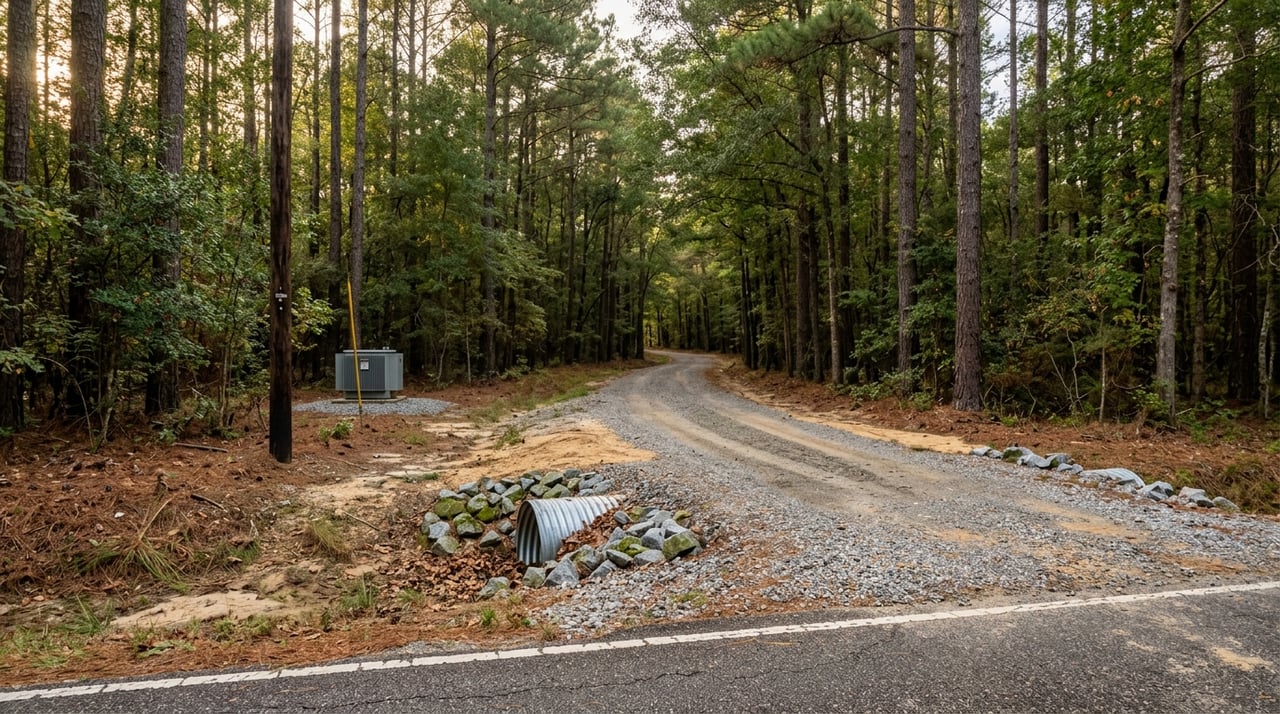
If you are trying to price land around Sparta or near Lake Sinclair, acreage alone will not tell the whole story. In this part of Hancock County, value often comes from a mix of timber, access, soils, utilities, lake influence, and future use potential. When you understand what buyers and appraisers actually look at, you can make smarter decisions whether you are buying, selling, or settling an estate. Let’s dive in.
Why land values vary here
Around Sparta and Lake Sinclair, many tracts are not one-dimensional properties. A parcel may have timber value today, recreational appeal right away, and development potential later, which means the market can look at the same acreage in more than one way.
That local context matters. According to the UGA Extension Hancock County report, timber is one of the county’s top commodities, with 42,100 acres valued at about $1.305 million in the 2024 farm-gate report. That helps explain why land buyers in this area often evaluate both the dirt and the standing timber.
Statewide benchmarks can also offer useful background. The USDA 2024 land values release reported Georgia farm real estate at $4,270 per acre, cropland at $4,120 per acre, and pasture at $4,700 per acre. While those figures do not price timber tracts directly, they help frame mixed-use parcels that include open ground or pasture potential.
Timber value is highly local
One of the biggest drivers of land value around Sparta is timber, but timber does not trade like a simple flat price per acre. Value depends on what is growing, how mature it is, what condition it is in, and how efficiently it can reach a market.
UGA’s 2025 timber outlook notes that timber markets are local because logs are bulky and usually move only 50 to 75 miles to mills. In practical terms, haul distance, mill access, and product class can affect pricing almost as much as tract size.
What buyers look for in timber
When buyers size up a timber tract, they are often asking a few basic questions:
- What species are on the property?
- How old is the stand?
- Is the timber pulpwood, chip-n-saw, or sawtimber?
- How dense and healthy is the stand?
- Has the property had storm damage or harvest issues?
- Can logging equipment access the tract efficiently?
The Georgia Forestry Commission explains that a professional forester can help assess harvest levels, determine product class, and prepare a timber appraisal. That is especially important if there has been storm damage, since salvage prices can fall to 10% to 50% of typical value when logging is harder and quality is less certain.
Timber is not added dollar-for-dollar
A common mistake is assuming that standing timber simply stacks on top of land value in a straight line. In reality, the market usually discounts for risk, access, harvest timing, and local mill demand.
That means two tracts with the same acreage can sell very differently. A well-stocked, accessible tract with merchantable timber may attract more interest than a similar parcel with lower-quality stands, poor access, or storm-related damage.
Soil and topography matter more than many owners expect
If a parcel may support farming, homesites, recreation, or timber growth, the quality of the land itself becomes a major pricing factor. Soil, drainage, slope, and topography all shape what the property can realistically support.
The USDA Economic Research Service notes that farmland value is influenced by parcel-specific factors such as soil quality, rural amenity value, and urban proximity. In a market like Hancock County, that means soils can affect not just agricultural use, but also septic suitability, road placement, building sites, and timber productivity.
The NRCS Web Soil Survey is the official current source for soil survey information. For buyers and sellers, that makes a soil review one of the most useful early steps when trying to understand value.
Why soils affect price
Better soils and workable topography can increase flexibility. That flexibility often translates into a broader buyer pool.
For example, a tract that supports healthy timber growth, workable access, and future homesites may draw interest from more than one type of buyer. A tract with poor drainage or limited buildable area may still have value, but the pricing story usually looks different.
Access, frontage, and utilities can shift value quickly
Road frontage does not automatically guarantee a higher sale price, but it often improves access and can influence future use. If a tract has legal access, practical entrance points, and usable frontage, buyers may see more flexibility for building, recreation, or possible division.
The Appraisal Institute’s land valuation guidance highlights factors such as accessibility, size differences, public utilities, location, and changing market conditions. Around Sparta and Lake Sinclair, that framework is especially useful because many parcels differ sharply in how usable they are.
Utility availability changes the buyer pool
Infrastructure can be a major value driver. A tract with nearby water or sewer, or one already suited for well and septic use, may appeal to a very different buyer than a tract that needs extensive upfront work.
The Town of Sparta utility information states that new water and sewer tap fees are $1,500 each inside city limits and $3,000 each outside city limits, with owners responsible for lines from the house to the road right-of-way where hookups are available. That kind of cost can materially affect a buyer’s budget and what they are willing to pay for the land itself.
Lake Sinclair frontage can create a premium
Land near Lake Sinclair often trades differently from inland acreage because the lake adds recreational appeal and a different lifestyle use. Waterfront can attract buyers looking for boating, fishing, swimming, or a future home site with water access.
Lake Sinclair includes 15,330 acres of water and 417 miles of shoreline, according to the U.S. Forest Service recreation overview. That scale helps explain why shoreline property often carries added interest in the market.
Not all lake frontage is equal
Waterfront value is not just about having shoreline on a map. Buyers also want to know whether the lot can actually be improved the way they expect.
Georgia Power’s shoreline management rules matter here. The Lake Sinclair recreation and shoreline guidance notes that shoreline activity on Georgia Power land requires a valid permit, and new structures must also meet county setback requirements and any applicable county building, septic, and land-disturbance rules.
That means two lakefront tracts with similar frontage can price very differently if one is easier to permit and improve. In other words, the market usually pays for usable waterfront, not just theoretical waterfront.
Zoning and subdivision potential matter
For some buyers, especially investors, builders, or families planning multiple homesites, future use can be a large part of value. A parcel’s ability to be divided, improved, or developed often affects pricing as much as its current use.
The Hancock County Planning and Zoning Department enforces zoning ordinances and land-development regulations and ties land use to the county comprehensive plan and future land use map. That makes subdivision potential a regulatory question, not just a physical one.
Highest and best use drives pricing
In appraisal terms, the key question is often highest and best use. That means asking what use is most likely, legally allowed, physically possible, and financially reasonable for the property.
The Appraisal Institute notes that land valuation may involve rural land, timberland, waterfront property, and prospective subdivisions, with adjustments for utilities, accessibility, location, and other factors. Around Sparta and Lake Sinclair, a sound pricing strategy often separates:
- Raw land value
- Timber value
- Waterfront or recreational premium
- Development or subdivision potential
That layered approach usually gives a clearer picture than relying on a simple per-acre estimate.
Taxes and carrying costs affect net value
Owners sometimes focus only on sale price, but net proceeds can also depend on tax treatment, holding costs, and timing. That can be especially important for estate sales, inherited land, or timber tracts being held for a future harvest.
The Georgia Forestry Commission tax and estate planning guidance explains that timber in Georgia is taxed at 100% of fair market value when sold or harvested, and some agricultural or forest land may qualify for conservation use or agricultural preferential assessment. For heirs and estate administrators, those details can influence whether it makes more sense to sell now, hold longer, or market the tract based on a different strategy.
What sellers should gather before pricing land
If you want a more defensible price opinion, good documentation matters. Strong prep work helps buyers understand the opportunity and reduces uncertainty during negotiations.
Before bringing a tract to market, it helps to have:
- A recent survey or clear GIS map
- Proof of road frontage or easement access
- Soil information from the Web Soil Survey or related reports
- A timber inventory or timber cruise
- Utility, well, or septic information
- Any shoreline approvals or permit details
- Zoning or land-use information relevant to future plans
This kind of package can help the market see the property more clearly. It also supports appraisal-backed pricing, which is especially valuable when a tract has multiple possible uses.
Why appraisal-backed guidance matters here
Land around Sparta and Lake Sinclair can be difficult to price because the value story is rarely simple. Timber, soils, road access, shoreline rules, utility costs, and future use potential can all point the market in different directions.
That is why buyers, sellers, and estate representatives often benefit from a valuation approach that looks beyond acreage and studies the property as a whole. When pricing is grounded in the tract’s actual characteristics and likely market use, you are in a much stronger position to make a confident decision.
If you are considering a sale, evaluating inherited land, or trying to understand what a tract near Sparta or Lake Sinclair may be worth, The Howard McMichael Team offers appraisal-informed guidance and personalized support for complex land and waterfront decisions.
FAQs
What drives land value around Sparta, Georgia?
- Land value around Sparta is often shaped by a mix of timber quality, soil conditions, topography, access, utilities, and possible future use.
What affects timber value in Hancock County?
- Timber value in Hancock County usually depends on species mix, stand age, product class, tract access, mill distance, and whether the timber has any storm damage.
Does Lake Sinclair frontage always increase property value?
- Lake Sinclair frontage often adds recreational appeal, but value also depends on permitability, shoreline rules, setbacks, and whether the lot can be improved as expected.
Does road frontage increase land value near Sparta?
- Road frontage can help value by improving access and flexibility, but the impact depends on how usable the frontage is and whether it supports the tract’s likely highest and best use.
What should a seller prepare before listing land in Hancock County?
- A seller should ideally gather a survey or map, access documentation, soil information, timber data, utility details, and any zoning or shoreline approvals before pricing the property.